Showing posts with label Tibet. Show all posts

Tuesday, July 3, 2012

Adorable Red Tibetan Mastiff Puppies

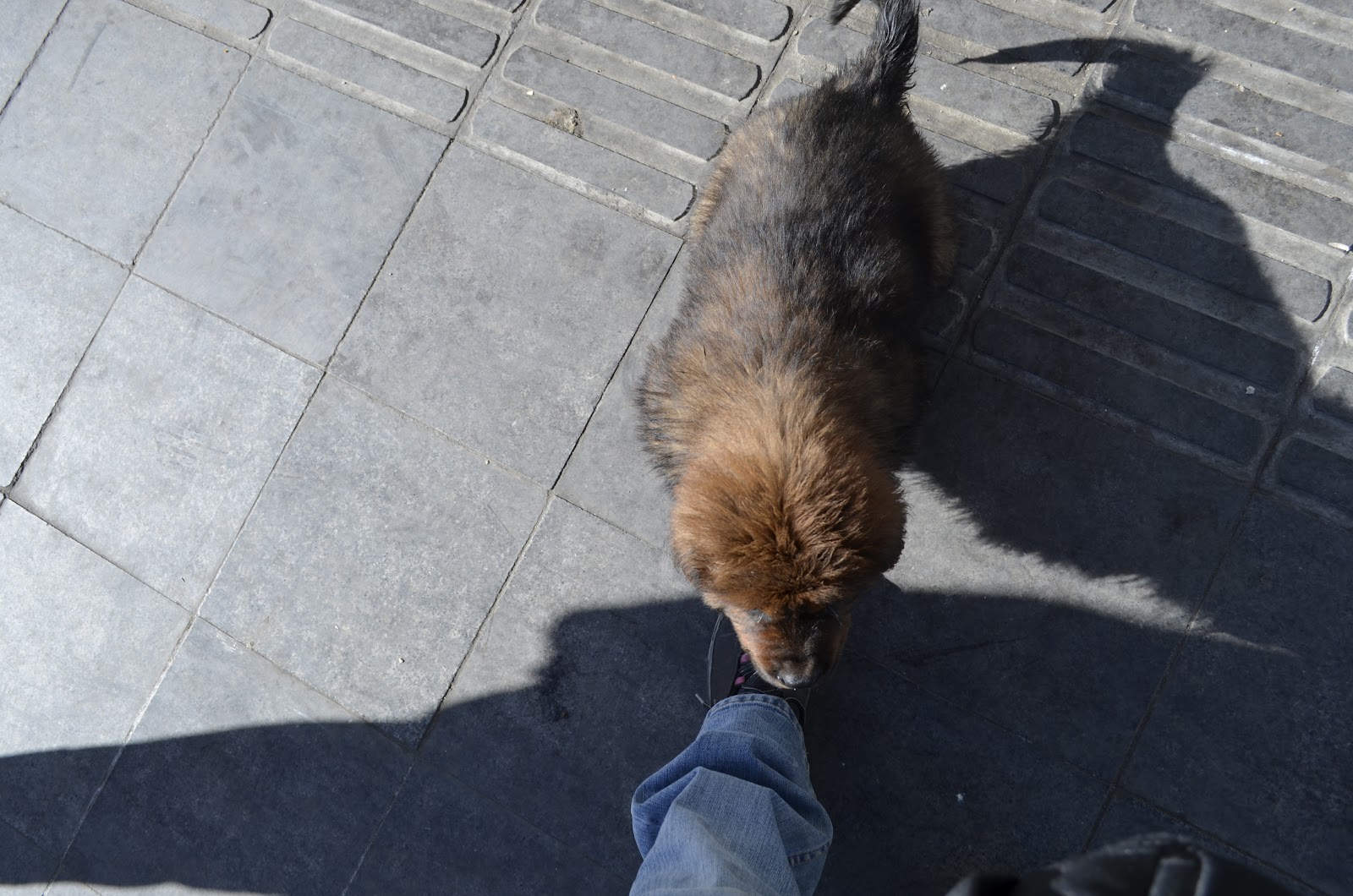
The title says it all! As a treat, here are some photos of adorable red Tibetan mastiff puppies. While living in Lhasa during the fall of 2011 for three and a half months, I used to pass by a vet's office every day whenever I left the hotel. Inside there was a giant bear of a Tibetan mastiff (she's the one that I am playing with in the photos) and I always wondered why she/he was there. I assumed that the owner had gone somewhere and was boarding the dog until I saw a spillage of fluffy puppies! I have no idea how she fit so many giant babies in her body...

Giant Tibetan mastiff puppies!
Very sedate red Mastiff
So fluffy!
Their mother had that drugged look as well!
So many adorable mastiffs.
These puppies were surprising calm unlike pug puppies which are insane.
How did they all fit?!
They were so soft
The very cute face of a disgruntled red mastiff puppy
Fiiiiinally curious
These would be great for kids. Completely unfazed.
So adorable!
It's crazy to think how massive these dogs will get.
Sibling solidarity
These were honestly the calmest puppies I have ever seen. Nothing really seemed to rouse them out of a slow stupor. I don't know if this is a breed thing, a genes thing, or just the time of day, but they were basically stuffed animals that occasionally sauntered. Love me some mastiff puppies!

Monday, June 25, 2012

Highland Trekking Initiatives Lhasa

*Pictures at the bottom.

The post has been a long time coming and I am so thrilled to finally have time to write about Highland Trekking Initiatives. If you want to go trekking in Lhasa, this is the company to go with. I think that everyone should know about Highland Trekking Initiatives and its founder, Angie, is one of the most amazing women I have ever met. HTI is a trekking company that leads tours around Lhasa. I really think that this is an incredible company and deserves to be out in the world. I know that now is not the best of times to try to get into Lhasa but if you have the opportunity, take it. Angie can help you with your travel permit.

For those who haven't been following my blog, I lived in Lhasa for three and a half months in the fall of 2011. During this time I often went to La Bon Vie (yes, it's spelled wrong, it should be La Bonne Vie) for coffee and delicious pancakes and waffles. Almost every single time I went I saw this woman sitting in a corner surrounded by papers and typing furiously at her laptop. I never once got up the courage to approach her but I always noticed her presence. About a month and a half in this woman walked up to the Boy and I and asked what our stories were. We had been there so long that she knew we weren't tourists and wanted to get to know us. This is Angie. She is fearless, outgoing, and direct.

Angie has lived in Lhasa for fourteen years. She is a nature conservationist who runs HTI. She collaborates with nomadic communities all around the plateau in order to bring trekkers to little known areas. All of the profits she makes gets funneled back to the nomads and goes to the preservation of their grazing lands. All of her routes are those known only to nomads so that no other trekking groups hike her areas. It is really fantastic knowing that you won't run into a herd of people as you are trying to enjoy the scenery.

During the fall I was unable to go on one of her treks so I returned to Lhasa in January with the sole goal of going on a tour with her. The really great thing about her company is that she runs treks that range from six hours to seven days and up. If you have a free afternoon while in Lhasa, hit up Angie and she'll take you out for the day. Since I went during the winter season, I was only able to do a day hike but it was one of the top three highlights of my entire time in Lhasa. We even got to hop across some frozen rivers and it was really amazing being able to hear the babbling water underneath the thick layers of ice. I hope to be able to go back in the future and do a full week long hike with her.

Also, if you are worried that you have to be in spectacular shape, let me set your mind at ease. The day trek that I did was a very, veeeerrrrryyyy gradual climb and Angie sets an excellent pace. Just stay behind her and you'll be golden. Angie always brings along one of her other guides and we were lucky with the lovely Lhamo, who had an uncanny ability to be able to tell where solid ground was. 

If you do a trek with Angie, which I HIGHLY recommend, here are some helpful links:

Her website: http://www.nomadictreks.com/

Her Facebook page: HTI Facebook Page

If you google HTI, this old website will likely come up:

http://www.highlandecotreks.com/    - Ignore it, that is her old website.

*As of January 8th, 2013, her site seems to be down. In order to get in touch with Angie here is a link to another agency, Shigatse Travels, who will be able to assist you with your permit as well as with Angie.


Before I get to the pictures, here are some tips:

1. Altitude sickness is not a joke. Do not be THAT guy or girl that thinks you are such a hot shot athlete that you can just charge up a mountain in the Himalayas. You will get sick. Take it slow, enjoy your time and don't worry so much about speed.

2. Do not litter. This is an eco-tour and even if it wasn't, always leave a place better than you found it.

3. Sunscreen is pretty important! You are much closer to the sun and you will feel it.

4. Hydration is key. Making sure to drink lots of water diminishes the risk of altitude sickness. Always carry a bottle with you.

5. Dress appropriately. It can get chilly at night even during the summer, so pack a sweatshirt. Make sure to have hiking boots or sneakers that are comfortable and sturdy enough to last.

Finally the pictures. Notice that some are of the same places just during the winter as opposed to the summer:

Getting started!
Lhasa countryside
Himalayas!
I think this yak was a little spooked.
I think this man was quite confused that we were driving around his area.
Snowy wilderness
Sun burst!
There were a ton of sheep
We had to traverse a couple of frozen rivers.
This is a nomad camp that is abandoned in the winter.
Our fearless leader Angie!
Angie of Highland Trekking Initiatives
Lhamo showing the Boy where to cross the river.
Cool mountain plant.
Angie was giving us eco lessons during the hike! This lichen shows that the air here is still healthy and smog free.

This was a slightly larger frozen river so Lhamo pushed ahead and showed us what was what.
How far we have come!
This is actually the campsite for those doing overnight or the first campsite for those doing longer treks.
Who doesn't love prayer flags?
Yak did not want to move so this Tibetan woman just shoved it aside.
*Photo credit: Highland Trekking Initiatives
*Photo credit: Highland Trekking Initiatives: Blue Sheep
*Photo credit: Highland Trekking Initiatives
*Photo credit: Highland Trekking Initiatives: Pack donkeys
*Photo credit: Highland Trekking Initiatives: Pack yaks
*Photo credit: Highland Trekking Initiatives: Potala Palace view
*Photo credit: Highland Trekking Initiatives
*Photo credit: Highland Trekking Initiatives: Recognize the same rock formation from above?
*Photo credit: Highland Trekking Initiatives
I hope that if you do end up going to Lhasa that you take advantage of the amazing opportunity that Angie provides.

Friday, November 18, 2011

A Snapshot of Lhasa

 
Monks in a department store. Clearly making some prayer rounds.

 The majority of articles on Tibet are filled with burgundy-robed monks silently twirling handheld prayer wheels. In a red columned assembly hall, they sit cross-legged on worn red pillows as shafts of light stream down from the rafters. Atop buildings and connecting pillars, prayer flags flutter in the wind as the faded yellows and greens contrast sharply with the piercing blue of the sky. Outside saffron stained temples, faithful adherents garbed in dull black and brown chupas prostrate themselves in front of statured gods. Palms together in prayer, they swing their arms from their forehead to their chest before gingerly falling to their knees and lying face down on the dusty, stone floor. After a moment of stillness, they get up and start the process over again. Staring out at this show of faith, wide-eyed deities with finely arched eyebrows sit with silky white prayer scarves draped around their shoulders and laps. Some faces are painted gold, others red or blue, as their hands grasp various instruments wrought in brass. The snarling faces of a few protector deities are covered up since they are deemed too terrifying to behold. During special occasions, the coverings are removed from their faces, revealing bulging eyes and fangs sprouting from grimacing mouths. Some of these deities sit astride various steeds as they trample demons whose bodies are pinned to the ground. Lining the front of these beings are iron troughs that look blue in the lighting. Hammered designs can be seen twining around the bases. The pungent smell of yak butter and burned juniper wreathe any who approach the twinkling of the lit altars. Pools formed in the soft, off-white wax landscape reflect serried rows of tiny flames. The flames dance, flickering and twisting whenever the faithful dribble liquid butter onto cratered mounds. Others use spoons to flick clumps of solid butter which create mountains surrounding the lakes encircling the flames. Waves of people pass through the various chapels and murmured prayers create a soothing lull that fills the air.

This is the classical image of Tibet, but Lhasa today is a burgeoning metropolis. Branching out from the walls of the temples, winding white walled streets give way to wide paved roads. Cars swerve around darting pedestrians while pedestrians weave around cars parked on sidewalks. Dogs of all shapes and sizes, in various states of uncleanliness, navigate through vehicles and people with their tongues happily lolling. Some have tinkling bells, while others are adorned with ratty red mane collars, which transform even the smallest Lhasa Apso into a fierce, albeit adorable, snow lion. In addition to multi-colored, tarp covered market stalls, department stores glitter with polished floors and bright fluorescent lights. Tibetan women hawking neon yellow blocks of yak butter contrast with manicured saleswomen displaying the latest brand name perfumes and make up. Those same burgundy robed monks stroll through the lanes between clothing sections, chatting on their cellphones. Street-side dentist stalls with rusted, peeling signs advertising gold emblazoned teeth are eclipsed by three-story centers with dental chairs and sterile equipment. Heaps of white curd, dried meats, and fungi compete with well-stocked supermarkets filled with plastic sealed soy sauce eggs and knock-off Oreos. 

No matter where you go in the world, you will never be able to escape dogs dressed in cute clothes.

Backpacks and leopard print are for all activities.

Skateboards galore!
The central tourist hub of Lhasa is the Barkhor, a wide-ranging market that sprawls around the Jokhang Temple. Armed with giant cameras with even larger lenses, packs of international and domestic visitors roam between stacks of thangka paintings and turquoise jewelry. Swept up in the clockwise tide of practitioners that circumambulate the Jokhang, visitors find it hard to leave. There are tons of restaurants, sites, and shops within this maze, so barring trips to major sites outside of this area, most tourists only see one side of Lhasa. Neglecting the rest of this rapidly expanding city is unfortunate since it has so much more to offer. Take, for example, cuisine. There are food stalls and tea houses everywhere. While these offer tasty fare, there are tons of other restaurants in the city that are overlooked. One such is called Hot Space. It is a hotpot restaurant that is renowned among the local Chinese and Tibetan population, but very rarely frequented by tourists. There is usually a wait. To keep patrons entertained, a row of computers boast the addictive game Plants versus Zombies. Waitresses even bring cups of juice so that those waiting will be hydrated for the spice. When ordering, the staff is incredibly helpful and will offer suggestions. This is very important since the menu is entirely in Mandarin. Due to the dearth of foreigners, it’s possible that the meal will end with singing and a flurry of white prayer scarves. This is just one of the many experiences awaiting tourists who explore outside the norm.

Dico's replaces McDonald's as the fast food of choice.

Prime hotpot goodness.
Lhasa is in the midst of industrial, cultural, and technological development. The giant St. Regis Hotel resort occupies an entire block, and it’s not even a small block. Likewise, a Four Seasons Hotel has also sprung up with a fancy restaurant that serves Hong Kong delicacies. There is also a large computer center with a roller skating rink on the top floor. While historical sites like the Potala Palace and Drepung Monastery should be the focus of any traveler’s sojourn to Lhasa, exploring the more modern areas is well worth the time. There is nothing like walking past the daunting walls surrounding St. Regis, straining to gain a glimpse inside while, on your other side, stalls are filled with yak carcasses. Meanwhile, children of all ages, who never tire of seeing foreign faces, will good-naturedly call out “hello” as they pass by with baseball caps balanced precariously on the tops of their heads. Playboy stores are couched between dry cleaners and tea houses where Tibetan men in fedoras sit outside playing various games with tiles. Part of the charm of Lhasa is seeing this unique mixture of cultures and experiencing the growth of a city firsthand. Lhasa cannot be limited to a single perspective and travelers should take the new with the old. 

Technology surrounds the ancient Potala Palace.

Globalism at its best.