Wednesday, April 10, 2013

Istanbul: A Tour

Night shot of Istanbul with the Blue Mosque, Yeni Mosque, Hagia Sophia and Galata Bridge

Istanbul is one of my favourite cities in the world. I have been twice and will head there a third time in a couple of weeks. While it is a huge sprawling metropolis (it spans two continents), there are a few areas that I now know fairly well. Having absolutely fallen in love with the city, I highly recommend it to everyone. There is something to appeal to all interests and it is probably one of the most kid-friendly places that I have ever been (well, all of Turkey is incredibly fond of children). The places that I write about are for people who have only a couple of days to spend and a fairly tight schedule. If this is your second or third time, skim the list to see if there is anything that you have missed. Here is a brief introductory guide to Istanbul:

Overview and practicalities:

1. Always travel with a universal adapter. These bad boys pay for themselves when you aren't scrambling to find a plug to charge your electronics. 

2. Turkey's outlet is two round prongs and it is 220v. However, given most technology these days, you won't have to worry about anything shorting out.

3. Visas are available in Ataturk Airport right before you go through immigration. Just have $20 cash exact change (for US citizens). Make sure to head to the visa booth before you get in line for immigration!

4. There are ATMs right in Ataturk for a whole bunch of different banks.  There are also change shops all around the city. Try to hit up a couple and compare the exchange rates because they are different.

5. There are two major airports in Istanbul: Ataturk (IST) and Sabiha Gokcen International Airport (SAW). Ataturk is the airport on the European side and it is about a 30-40 minute drive to Sultanahmet. Sabiha Gokcen is on the Asian side and it is about an hour and a half drive to Sultanahmet with traffic (although I read a horror story that said they were stuck for four hours). If you are flying to SAW, I would recommend booking a private transport, although you can go the much cheaper public transport route. Make sure you know what airport you are going to/from since a mistake will cost you the flight.

6. A cab from Taksim Square to Sultanahmet cost me about 12-14 lira. If you are traveling with a group of four or more, take the cab. It will be the same price as the tram but WAY less crowded. A cab ride from Sultanahmet to Eminonu will likely be cheaper because it is closer. If you take a cab, ALWAYS make sure they put on the meter so they can't cheat you.

7. Watch your stuff on the tram. It gets really, really packed and is a prime place for pickpockets.

8. Food can range anywhere from 50 kurush (cents - this is for the stuffed mussels) to 30 or more lira. Restaurants along the tram line are going to be more expensive unless you go for street-side food or takeaway wraps.   

In Istanbul:

1. I recommend first-time travelers stay in Sultanahmet. It is the old city and has the greatest cluster of historical sights. The best method to getting from Ataturk to your hotel in Sultanahmet is taxi. To get to Sultanahmet it costs 45 lira (ish $25) and it is pretty reliable since there is a specific airport road that is separate from the regular traffic. Another method you can use is the metro.  There is a line that takes you to the city and from there you transfer to the tram line. You can transfer at Zeytinburnu and then walk a little bit to catch the tram towards KabataÅŸ, and then get off at Sultanahmet. Another option is to get off at the end stop in the metro called Aksaray and then cab to Sultanahmet. The metro and tram only really cost a couple of lira coins. You need to make sure you have coins on hand to get the tokens that you use to get through the turnstiles. Otherwise you can spring for an Istanbul public transport card (Istanbulkart) and then use that for your whole stay. Pay 10 lira for the card and then load as much money onto it as you want. You can get this card at Ataturk airport as well as in shops around town. You can also keep reusing this card for the same entry point, so if you are traveling with multiple people, you can all use that one card.

The area where you get tokens for the tram and metro in Istanbul.
If you really aren't too concerned with the historical sights of Istanbul and you would rather be in a clubbing area, then stay near Taksim Square, preferably along Istiklal Street. From Ataturk to Taksim, there is a bus (around 10 lira per person) or you can also use the metro/tram combo and get off at the end stop of Kabataş, and then use this other mini tram called the Füniküler or walk.

When looking for hotels, follow the tips that I outlined in my post Planning a Trip. ALWAYS check multiple sites when booking anything and make sure you see the total amount including taxes before you click book.

I have stayed in both Osmanhan Hotel and Sultanahmet Suites and can recommend both. I booked the bottom room in Osmanhan since it is the cheapest, and for Sultanahmet Suites I stayed in their largest apartment with four people and found it wonderful.

In terms of where everything is oriented in relation to each other, it goes Ataturk, Sultanahmet, Galata, Istiklal and then Taksim.  

2. Sultanahmet is the part of the city with the Blue Mosque and the Hagia Sophia. These are right across from each other. The Blue Mosque is free to go in, but it is closed during certain times for prayer. They provide you with scarves to wear if you are immodestly dressed (showing shoulders, legs, etc.). The Hagia Sophia costs about 25 lira and you don't have to worry about dress code.

Night shot of the Blue Mosque.

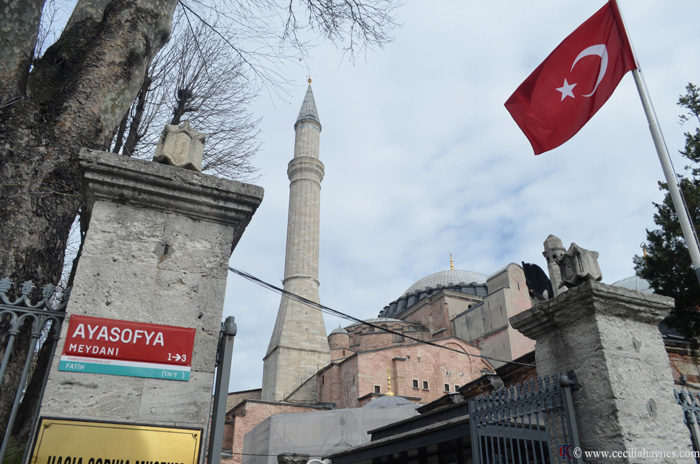
The Hagia Sophia which is across from the Blue Mosque

Information for the Hagia Sophia

Courtyard of the Blue Mosque
Getting the recycled bags that you use to store your shoes in

Ceiling of the Blue Mosque

Scarves that you use to cover yourself (they are laundered and smell great)
You will also find many other artifacts scattered all around the area. Keep a sharp eye out! A lot of these are to the right of the Blue Mosque if the tram road is behind you and the Hagia Sophia is to your left. They are on the side of the Blue Mosque.

Ancient Obelisk sign

Actual ancient obelisk next to the Blue Mosque
Here is one of the obelisks in relation to the Blue Mosque

The Serpent Column next to the obelisk and the Blue Mosque
3. Topkapi Palace is to the right of the Hagia Sophia if you are facing it. There is path that leads you right there. It costs 25 lira to go in.This is worth seeing for the fact that it has the staff of Moses and other artifacts. If you want to go and see the Harem section, you have to pay an extra admission and you should probably go early since they allow only a certain number of people a day.

Entrance to Topkapi Palace as photographed from the nice outer garden
4. The Basilica Cistern is on the other side of the tram street. The tram street is the main street that parallels the blue mosque and the Hagia Sophia (if they were behind you). It is on the side closer to the Hagia Sophia and you can follow the signs to get there. The entrance fee was 10 lira.

The tram street with the Hagia Sophia behind me

Sign for the Basilica Cistern

Information about the Basilica Cistern

Inside the Basilica Cistern. There are even fish down there!

One of the Medusa heads in the Basilica Cistern
 5. If you are facing the tram street with the Hagia Sophia/Blue Mosque behind you then you get to the Grand Bazaar by turning left and walking along the road. You only really need to go here if you want to go shopping. Even then, you might want to try for less touristy areas since the prices are hiked up. I actually found a wholesale lamp store while wandering around and got my hanging lamps for WAY cheaper than what was being offered in the Grand Bazaar.

6. From the tram road you can also get to the Suleymaniye Mosque. Go left for a little bit and then take a road that is perpendicular to the tram road to the right (if you are walking towards the Grand Bazaar). It would be best if you had a map and you can also ask for directions. You can actually be inside during prayer, so you don't have to worry about the timing. They provide you with scarves if you are immodestly dressed (showing shoulders, legs, etc.). From here you can get to the Bosphorus by walking downhill.

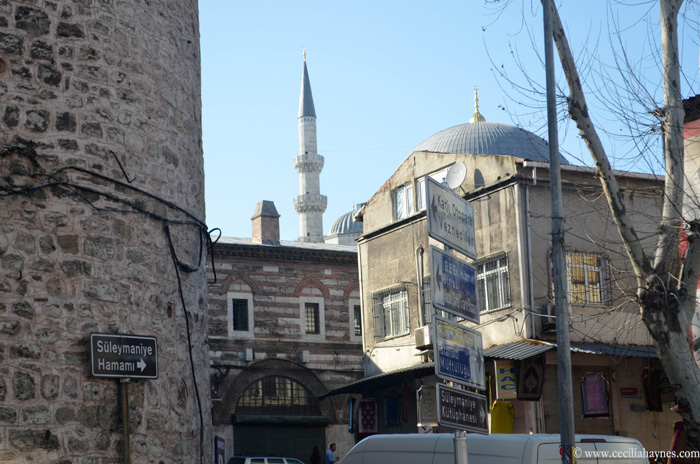
Following signs to get to the Suleymaniye Mosque

Tourist entrance for the Suleymaniye Mosque

Inside Suleymaniye Mosque during prayer
7. I would recommend a stop in this restaurant: Mimar Sinan Teras Cafe. It has a spectacular view from the rooftop and you can actually see it from the backside of Suleymaniye Mosque if you were looking towards the Bosphorus.


Sign for the Mimar Sinan Teras Cafe

The terrace part of the restaurant. That is Suleymaniye Mosque and the Bosphorus is behind me

8. To get to the Bosphorus you can either walk from Sultanahmet and follow the tram line to the right or pass by the Suleymaniye Mosque. You can also take the tram which costs 3 lira. Basically you are headed to Eminonu, which is the port for the side you are on if you stay in Sultanahmet. In Eminonu, you will find the ferries that will take you to the Asia-side port of Kadikoy. I definitely recommend the ferry since you will see some fantastic views of the Sultanahmet area. The ferries are also pretty frequent, so you don't have to spend long in Kadikoy, unless you want to. It is also fun to see the seagulls and the people feeding them. Fair warning: it gets crowded trying to get on the ferry so watch your stuff and get your tokens in advance! There are a series of boat houses which have the name of where you want to go as well as the ferry time. You can also look online for the ferry times.

Signs to get to Kadikoy from Eminonu

One of the tokens you use to get on the boat

Ferry line!

Sea view of the Blue Mosque and the Hagia Sophia

Sign to get back to Eminonu from Kadikoy

Feeding the flocking sea gulls on the way to Kadikoy
9. In Eminonu, you will find the Spice Bazaar. It is right next to Yeni Mosque which is by Galata Bridge.

Side of Yeni Mosque with the Spice Bazaar to my right

Spice Bazaar in Istanbul
10. To go from Eminonu to the Karakoy port (the area which has Galata Tower, Istiklal Street and Taksim Square) walk across Galata Bridge. This area is still a part of the European side of Istanbul and it spans a body of water called the Golden Horn. There are people fishing on the top and it has a ton of seafood restaurants on the bottom. This is a good place to watch the sunset.

Night shot of Galata Bridge with Galata Tower and the seafood restaurants

Fishing on Galata Bridge

Sunset shot of Galata Bridge
Definitely try the stuffed mussels that are littered all around this area. They are the best food in the world.

Delicious stuffed mussels in Istanbul
11. Galata Tower is on Karakoy side. After you cross Galata Bridge, just keep aiming towards the large tower which you will see peaking above the rooftops. When it becomes obscured by other buildings, follow the signs that will take you there. It is a 13 lira entrance fee and it was a 30 minute wait for us to get to the top. This is a spectacular place to watch the sunset for the 360 view it offers. Make sure to get there with plenty of time to spare. An hour before sunset should give you enough time to maneuver your way around the top.

Signs on the way to Galata Tower from Galata Bridge

Galata Tower! The first picture of this post is the view from the top. Go early

Long line to get into Galata Tower for sunset. Took me 30 mins
12. Istiklal Street/Avenue links Galata Tower with Taksim Square. This is a really fun street with lots of bars, shops and restaurants. From Galata, just ask people for directions to get here.

Night shot of the beginning of Istiklal Street
That's it for a quick overview of the European side of Istanbul (barring Kadikoy). I managed to do all this is about three days although you could probably squeeze it into two or even spread it out to four. There are plenty of other museums and sights to see, so if none of these interest you, just do a little research. 

Good luck and have fun!

Street art in Istanbul

Wednesday, April 3, 2013

Navigating Labels

A Third Culture Kid/Global Nomad as an expat in Turkey and working as a digital entrepreneur.

Introduction

Labels can be both incredibly limiting and extremely necessary. I have no issue with labels when they are self-identified. Labels can be used to project different sides of a person to the world. They give an immediate introduction, especially if everyone is on the same page for what different labels mean. That is where the problem lies. Labels mean different things to different people. There are also a ton of labels that can be applied to the same thing/concept/group. 

I am a mix. Most people when they see me think of only one side of my heritage. They cite my eyes as the sole reason why I should belong to one group and not another. Conversely, when I am surrounded by the other side of my heritage, then I am not enough for this group. I don't speak that language with the correct accent, I look too foreign to really belong. This one drop method drives me insane and it is applicable on both sides. 

To add more fuel to the fire, my ethnic makeup doesn't even begin to broach my upbringing. Taking all of these into account I am part American, part Hong Konger, part mainland Chinese, part Indian (north and south), and part Filipina. 

In order to condense my labels, this is how I identify myself: A mixed American and Hong Konger TCK who has grown up in China, India and the Philippines and currently lives in Turkey.

In the interest of clearing up some traveler labels, I have compiled a list of the most common identifiers for global nomad/wanderlust individuals. Bear in mind, this is how I understand the labels, so if you have a different understanding, please share! I would love to hear different perspectives on how people choose to share themselves with the world. Being able to identify yourself is empowering and it allows you the freedom to choose which side you want other people to see.

Expatriate

An expat is someone from one passport country who has decided to reside in another country. They will either live indefinitely in this other country or will continue to move around. When/If they return to their passport country, they will cease to be expats. They will be people who have lived an expat life. This move can be for work, retirement, or just living in another place. Expats usually live for at least one year in the other country, but usually reside overseas for more. Expats are not looking to give up their passport country as a nationality.

Global Nomad (Kid)

A global nomad (kid) is another term that could be applied to me. They are people who grew up in a country or in multiple countries that were not their passport country. This label gives the impression of upbringing (pre-18) and so would only be applied to minors who have lived overseas. This term can be used for people who have even lived just one year abroad.

Third Culture Kid

I choose to use Third Culture Kid because it conveys more effectively what my upbringing was. Like a global nomad, a Third Culture Kid is someone who grew up in a country or in countries that were not their passport country. This title is used to explain how these children take elements of their passport country, their host country and then create a third culture that encapsulates these quirks. Other aspects that can be included in the third culture are parental cultures as well as the cultures of the various friends that you make through this lifestyle.

For people like me who have lived in more than just one other "foreign" country, this can be a bit of a clumsy label because you almost want to keep adding in on a fourth culture or a fifth, etc. At the same time, this third culture that you will create can continue to grow as you experience new nations.

I would also make the argument that even kids who have gone to an international school in their passport country pick up components of being a third culture kid. They are immersed in an environment where all of their friends are from different countries and they learn how to navigate different spheres of communication that are separate from their own culture. 

Adult Third Culture Kid 

I am technically an Adult Third Culture Kid since I am twenty four years old. I don't choose to use ATCK because I think that it just adds to the confusion of acronyms. If you start tossing around terms like TCK, ATCK, MK (missionary Kid), FCK (first culture kid - basically someone who did not grow up as a TCK and stayed in their passport country during their upbringing), etc., conversations can get quite confusing. Since most military/government agencies LOVE acronyms, I almost feel like we kids adopted that same penchant.

I would much prefer people understand what a TCK is before moving on to other terms. This sort of assumption of knowledge can muddle understanding, in my opinion.

Recovering Third Culture Kid

I actually wrote an entire post about Recovering Third Culture Kids.

Cross Cultural Kid

Cross Cultural Kid is a term that I just recently learned and it has the same meaning as a Third Culture Kid. CCK has the double benefit of potentially meaning a child whose parents are from different cultures. Here is the exact definition as given by Ruth Van Reken (one of the authors of Third Culture Kids: Growing Up Among Worlds): "A person who is living or has lived in--or meaningfully interacted with--two or more cultural environments for a significant period of time during childhood (up to age 18)."

Immigrant

An immigrant is someone who moves to a new country in the hopes of living there permanently and becoming a citizen in this new country. This is the distinction from an expat since expats are uncertain how long they will be abroad and have no wish to give up their passport.

Migrant

A migrant is someone who moves for seasonal work. My impression, although I really don't have much/any experience with this group, is that they are much more geared towards shifting wherever employment takes them.

Refugee/Asylum Seeker

A refugee/asylum seeker is someone who needs to escape their home/passport country. The cause can be persecution, war, or any number of other atrocities. Refugees flee to other nations in the hopes that they will be allowed to remain.

Digital Nomad/Entrepreneur 

A digital nomad/entrepreneur is someone who chooses to live abroad and funds themselves through online work. I am also technically a digital nomad since I earn money for my work by submitting curriculum to a center in Hong Kong via email. Digital nomads are fairly new. I think that this group will only continue to grow as more and more work shifts online.

Missionary/Business/Teacher/State Department/Military/Peace Corps/Volunteer

This is pretty much a label that describes people who are overseas for their work. In my experience, teachers tend to stay in one play the longest followed by business/missionary and then state department and military. Peace Corps is two years and volunteers range from a couple of months to indefinite. However, there are all sorts of different timelines for people who belong to these different groups.

Conclusion

I hope this helped a little bit in clarifying the different labels that are thrown around for people who travel. Please feel free to add on to this list or to add on to my explanations. Also keep in mind that as much as I am making distinctions, a lot of these blend together and people can ascribe to multiple labels. People may even change their labels as they grow or move or experience new places. The whole process of identity is constantly shifting, fluid and inclusive. It never stops as you accrue new terms over time.


Monday, March 4, 2013

Planning a Trip

Saas-Fee, Switzerland. Yes, there will be a full post on this magical place.
I think I should have become a travel agent for my career. Who knows, I might still in the future! The thing is that I love planning trips. I love planning trips almost as much as I love going on the trip themselves. Whenever I am stressed out or have a lot on my plate, I will drop everything and just spend a couple of hours researching a trip that I will most likely never go on. It is a bit of a sickness...

I am not a wealthy person. I have an income that comes from my free-lancing but I live on a pretty fixed budget that doesn't allow for extravagance. For those who have been following me, I know that you might be slightly incredulous. I travel. A lot. Traveling is one of those things that just seems to ooze privilege and imply a trust fund (especially for young twenties). I don't have a trust fund and while I know my parents are my safety net, I try not to risk a fall.

The big secret is that travel is no more expensive than many other hobbies/interests. It all depends on where your priorities lie. If you own a car, a house or that new expensive gadget, then that is where your money goes. If you decide you need that designer bag/dress/pair of shoes, then you budget for it and you spend big bucks on what makes you happy.

I use my money on travel. Anything that I have left over is spent on flights, hotels and activities. That is how I was raised and how I have continued to live my life. Growing up I never had the biggest TVs or the most expensive cars. Instead I went windsurfing in Bali. I saw Komodo dragons on Komodo Island in Indonesia. I went on vacations to Hong Kong and took a family trip around Europe. I don't buy designer stuff, I don't own a car (or need to pay for gas or car insurance) and I don't have a house. I don't go out drinking or partying at all and so none of my money goes to expensive bar alcohol. I don't have a monthly cable bill. I don't have an animal (although hopefully next year!) and I don't need to make vet payments. I don't have the newest phone. I actually have a trusty Nokia that I've had for years. Even with this phone, I don't pay a monthly fee. I do pay as you go. Little secret, the US is one of the most expensive places in the world to have a phone plan. It is ridiculous how much they charge you. I don't go out to eat. I buy local produce and cook at home to save money. That extra saved money goes right into my travel fund.

The other way that I skimp and save is that I use the following sites to help me plan trips:

1. Booking Buddy is my standby. It is reliable and it checks multiple sites. When the other window pops up I always choose either CheapOAir and OneTravel. These tend to have the lowest fares out of anything else that I have found. The one caveat is that they are non-refundable. I don't use Booking Buddy for hotels or anything, just flights.

2. Sky Scanner is a new favourite that I recently discovered in the last couple of months. It has some really great deals for when you search for specific dates since it scans every travel site and redirects you. Another handy way to use Sky Scanner if you don't have a specific date in mind is to enter in a starting city and then click ______________ to anywhere. It will then come up with a list of places/prices. I found a $200 roundtrip ticket to Egypt this way. Alas I can't go since I have reached my travel quota for a bit, but it was an awfully tempting price...

3. I was just introduced to Travel Zoo by a friend who found roundtrip tickets from DC to Istanbul for $399. This is a great site if you don't have any dates in mind and can pick up and go if you find a good price. They have all sorts of deals that you can browse if you sign up. It's a pretty easy sign up and so far I haven't been bothered by annoying spam emails from them. You can also give Flight Matrix a go, although I haven't personally used it.

4. Once I have booked my tickets, I head over to either Hostel World or Hostel Bookers and scope out some hostels/hotels. I tend to use Hostel World more but they both work fine. Watch out for the prices because they can mean per person and not per room. It is also worth checking out Hotels.com since they have served me well in the past. If you find a good price, it might also be worth calling the hotel/hostel themselves to see what kind of deal they offer over the phone. I have found them to be cheaper in Turkey when I have contacted them directly.

5. I am quite wary of local travel agents that you meet on site. I know for a fact that New Delhi is a haven for scammers and you really need to watch out for what money you put down. A couple of my friends were quite lucky backpacking around Turkey and finding reputable companies to book them for cheaper all-inclusive rates. Be smart about where you are and ALWAYS research where they are going to put you.

In terms of booking tickets and such for exact dates, I always aim to schedule arriving in the middle of the week. Prices shoot up when you aim to arrive Friday or Saturday. I also try to book on Sundays-Wednesdays since prices have seemed cheaper then. A rule of thumb I heard for booking was three months in advance for international and one month for domestic. If you are pretty flexible, then just try your luck with Travel Zoo and Sky Scanner for random deals.

This is just the tip of the iceberg for what I do when I plan a trip, so I will try to do a series of posts on this topic. I hope that this has been a helpful introduction!


Monday, January 7, 2013

Top Ten Turkish Quirks

A night shot of the Hagia Sophia in Istanbul.
I've been meaning to do this post for a while, but what better way to start the new year than to celebrate the wonderful culture in which I currently reside. Along similar lines as my Top Ten TCK Quirks, Top Ten Hong Konger Quirks, and Top Ten Lhasa Quirks, I have created a list of what I have encountered as the most common peculiarities of the Turkish population. Everything I list I have personally seen in Istanbul, Antalya, Alanya, and the Cappadocian region. 

None of these are intended as insults or a means to simplify/generalize an entire group of people into a list of ten. This is just a humorous compilation of observations and a brief introduction into a new society, one that I hope will inspire you to come and see it for yourself.

1. Sense of humor

Turks are a very fun group of people. They like to joke around and are quite playful. You will most likely see this when it comes to dondurma. Dondurma is Turkish ice cream and it actually has a different consistency than American style ice cream or Italian gelato. It's slightly more...sticky. I know that doesn't sound appealing but it is actually delicious and will not melt off the cone and onto your clothes. 

Due to its more viscous nature, the people manning dondurma stands will tease you by messing around with the cone. They will extend it and then flip it around, pretending that the ice cream fell before finally proffering the cone. It is actually very entertaining to watch and this is very commonplace.    

I also noticed this on the pirate ship ride I took here in Alanya. Midway through the trip, the captain put on a dress and then started gyrating around the top deck. Then one of the crew members did an impressive cliff jump before removing his pants and swimming around with his cheeks beaming up at the audience. Sure, this was all done in entertainments name but seriously, how many cultures do you know that would willingly make fools of themselves just to get a laugh?

Turkish swimming activities...

Our lovely Turkish captain.

2. Tea

By the time you leave Turkey, you will have drunk your weight's worth in tea. They serve tea with EVERYTHING. There is never a bad time for tea. Waiting to change money? Have some tea! Getting your hair did? Have some tea! Walking along the street? Come sit and have some tea! You must also have tea after finishing a meal, no ifs, ands, or buts.

One tip is that the famous apple tea is actually something concocted for foreigners. Turks found out that tourists aren't really fans of the regular black tea (they find it too bitter but I enjoy it) so they made a powder of sweet apple flavoring.

3. Backgammon

This is the board game of choice in Turkey. I actually got the Boy a dual backgammon and chess set for Christmas this year. No matter where you go, you will see a group of men huddled around a rickety table and yelling at the board. Of course, as they play, they will be drinking tea. There is another game, which I haven't yet found the name of, which makes people want to slam down hard on the table.

We still don't know how to play but that is one of my New Year resolutions.

The lovely mother of pearl backgammon set.

4. Grooming

If you have a lot of hair and are not sure what to do with it, come to Turkey. Turks know what to do with hair. They are experts in hair control. Hair that you don't even realize that you have will be dealt with.

I also maintain that Turkish women are the toughest bunch out there. My first week here, I went to a salon and did my nails, eye brows, and got a hair cut. I was literally crying in pain by the time I left. My nails looked great, my eye brows looked great and so did my hair, but it all came at a price: pain. Well, not really my hair until they decided to straighten it and so began the tugging, but for sure female grooming here is not for the faint of heart.

Men have it much better. The Boy has delighted in the attentions of the barbers here as they give him a little massage, lather him up and then carefully give him a smooth shave. The coup de grace is when they do one of two things:

       1. Make a mask of mud and put it onto the guy's cheeks. This is left to dry before it is
           carefully peeled off, taking all the cheek peach fuzz along with it.

       2. This is the more dramatic of the two. A little cotton ball is lit on fire and then they
           repeatedly whack this flaming cotton against the guy's cheeks in order to burn off the
           peach fuzz.

I never realized that peach fuzz was something to be dealt with. So, lesson to be learned by this: Women, enter at your own risk. Men, go and be pampered.

Flaming ball of peach hair.

Male grooming in Turkey.

5. Excessive friendliness

Turks are seriously the friendliest people that I have EVER met. I can't even count the number of times where I have asked for directions and they have just left whatever they were doing (some people even closed their shops) in order to lead me where I need to go. They didn't even want anything! They just did it to be nice.

There are folks who will probably cheat you but these are mostly found in tourist traps and even then, they are way nicer than some of those in the same capacity in India. Otherwise, the Turkish people are a delight to be around. I have never met a group of people who just wanted to be friendly for the sake of being friendly. I have literally met two rude people in the six months that I have been here.

6. Turkish patriotism

I am fairly competent when it comes to history (thank you AP world history) and I was aware of Mustafa Kemal Ataturk, the leader who essentially created modern-day Turkey out of the ashes of the Ottoman Empire. I did not realize just how fiercely proud Turks are of their founding father and their homeland. There are Turkish flags EVERYWHERE and I am just amazed at the overwhelming pride that this society has for their own country and founding father.

It is not a loud, in-your-face, obnoxious sort of patriotism. It is more a very open appreciation that proclaims "I am Turkish and Turkey is awesome." Love it.

Yes, that is Ataturk on a horse holding the Moon.

7. BBQs

First let me say that I love Turkish food. I am especially in love with Kahvalti (look for an upcoming post), which is Turkish breakfast. While this is very much a food culture, the Turkish love of barbeques is really noteworthy. Especially during the warmer seasons, families will go to nearby public barbeques every weekend and set up camp for the day. This is such a beloved part of their culture that there are actually numerous public areas which are chock-full of grills.  

Shot of the best kahvalti in Alanya. This can be found at Dizdar Garden up towards the castle.

Powdered grill sauce in Antalya

8. Yelling out nationalities

This is something that I have only noticed in really touristy areas. In order to get your attention, hawkers will start guessing your nationality. Walking down some of the main streets of Istanbul and on the boardwalk in Alanya, I will hear: "Hello, China!" "Hello, Japan!" "Hello, Thailand!"

One guy got so frustrated that a friend and I were not responding to him that he then proceeded to yell out, "Hello, @$$holes!"

I haven't really encountered this tactic elsewhere and found it to be particularly irritating. Pretty much on par with the incredulity I face whenever I tell people here that I am American. You would not believe the look of complete and utter disbelief that I get; because I am clearly lying and hiding the fact that I am Asian. A lot like China, nationality is tied to ethnicity.  

9. Love of children

Turkey is the most child-friendly place that I have ever been to. They LOVE kids here and I have never sensed any fear of stranger danger. One time, when the Boy and I were getting on an escalator at the local mall, we saw a little boy freak out at the moving staircase. His family had already stepped forward and were heading down as he started to panic. This Turkish girl (probably late teens) then stepped forward, grabbed his hand, and yanked him down. She even held his hand the whole way before returning him to his family at the bottom. That would not have been okay in the U.S.

Similarly, when the Boy and I were waiting in line to get our residency permits in the police office, we saw two of the police officers playing with a baby. I was surprised since I didn't think that officers were allowed to bring their kids to work. After taking a few photographs with the adorable child, the officers then walked towards our line and handed the child back to one of the other waiting families. Those officers just grabbed the random kid while the parent stood idly by and had a photo shoot! If you are one of those people who likes to pinch random kids' cheeks and pat their head, Turkey is the place for you.

10. Speed demons

I have lived in quite a few countries with poor driving records. Indian roads are death traps, Manila is so clogged that you have to add at least an hour of travel time for every five miles, and China is just as terrifying as India (especially when you get out of the huge cities).

Turkey has its own unique driving trait: speed. The roads are actually really nice here and are very clearly marked, so they aren't an issue. What you really need to look out for are people zooming. Maybe this is really an Alanya thing, since there aren't enough cars to really cause traffic pile ups, but I have never seen so many people speed so unnecessarily. They are really only saving themselves a minute, if that, and yet given the chance they will gun the gas pedal. It's quite terrifying! 


And that's it! One trait that I debated adding to the list was: Everyone is Turkish until proven otherwise. However, that only really applies to people who are already from the Mediterranean region or have heritage from around that area. The Middle East and the Indian subcontinent also apply.

I hope you enjoyed this list and that it inspired you to visit, for those who haven't been, or resonated with those who have. 

Saturday, January 5, 2013

A Kickstarter Thank You

Entrance to Nechung Monastery
In September, the Boy launched and successfully concluded a Kickstarter campaign to fund the completion of his dissertation. A couple of months late, but here is a heartfelt thank you to all of the individuals who contributed (in no particular order). You will now live on forever in the digital world:
Munni Krishna, Brogan Zumwalt, Kristen Muldowney, David F. Reynolds, Pratima Gopalakrishnan, Natalie Morris, Danielle Darwin, Richard D. Haynes, Zach Larson, Martha Backer, Alexander Pattenden, Dinah Russell, William Hensley, Zoe G. Powell, Vojta Drevikovsky, Kris J. Kraus, Esq., Anastasia Warzinski, Elizabeth Cody Kimmel, Karen Lang, Louise and Elwood Hardison, Amy Heller, Altaire Cambata, Kathleen Erndl, Valerie Roth, Michelle Bryan, Ben Kudria, Mark Hardison, Inness Ho, Ananth Anthes, Kari ‘Zael’ Alatalo, Erin, Berrywinkle, Victoria, Vivian and Quincy Tse, George and Wanda Bell, Michael J. Pucci, Marek Belski, Sean Knapp, Sally Ng, Andrea Arango, Gregory Krieg, Mickie Flanigan, Alex Chirico, Sheila Trevette, Clarence Cherry, Susan Law, Michael Essex, Abigail Corfman, James Bell, Malcolm Best, Vivian Rieracker, Cameron Bailey, Wesley and Sarah Pack, Helen Van de Walker, Patty Brown, Loretta Earley, Fred Moyer Sr., Barbara Jeffers, Jed Verity, and Aliya Sonnet.

The finished project site can still be viewed here: Nechung - the God of a Tibetan Monastery

The Birch Tree Chapel in Nechung Monastery, the oldest part of the monastery.